


Fires in Buildings: Why Prevention Must Go Beyond Installation
- Grupo AMJ
- Jun 28
- 3 min read

Updated: 10 hours ago
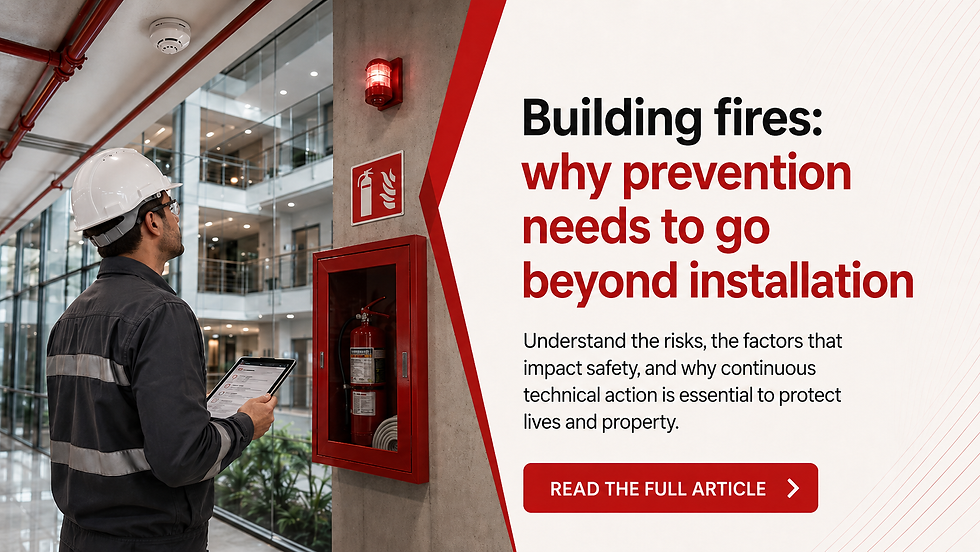
Whenever a fire affects a building, attention naturally turns to the consequences.
Property damage. Operational downtime. Risks to people's safety. But there is one question that should come first:
Was the fire protection system truly prepared to respond?
Having a fire protection system installed is essential.
However, installation alone does not guarantee that the system will perform as expected when it is needed most.
Fire prevention begins long before an emergency
and it continues long after the installation is complete.
Installation Is Only One Step
Fire protection projects are often associated with installing equipment.
Detectors, manual call points, control panels, notification devices, hydrants, and sprinkler systems are all important components.
However, every one of these devices depends on something even more important: proper planning.
Before installation, it is essential to understand the building's characteristics, identify potential hazards, and determine which solutions are appropriate for that specific environment. Every occupancy presents different risks.
A hospital requires a different strategy than a logistics center. An industrial facility has different needs than a commercial office building.
This technical assessment is what ensures that the fire protection system is designed for the actual risks of the operation.
Risks Change. The System Must Evolve Too.
Buildings rarely remain unchanged throughout their service life. New equipment is installed. Areas are expanded. Operations evolve. Layouts are modified.
Yet in many cases, the fire protection system is never reassessed.
The result is a system that remains installed but no longer reflects the current risk profile. That is one of the main reasons why fire prevention must be viewed as an ongoing process.
Prevention Depends on System Integration
An effective fire protection system does not operate as isolated components.
Fire detectors, alarm panels, suppression systems, smoke control systems, fire doors, and other safety devices must work together.
When these systems communicate properly, emergency response becomes faster and more coordinated.
When they do not, valuable seconds can be lost.
That is why system integration is just as important as selecting high-quality equipment.
Maintenance and Validation Are Essential
Even a properly designed system requires continuous attention.
Periodic inspections, functional testing, and preventive maintenance are essential to ensure that every component continues to perform as intended.
Whenever significant operational changes occur within a building, the system should also be reviewed and revalidated.
Fire safety is not something that is installed once.
It is something that must be continuously maintained.
What the Standards Say
This concept is also reflected in technical standards.
ABNT NBR 17240, which establishes the requirements for fire detection and alarm systems, highlights the importance of design, installation, commissioning, operation, inspection, and maintenance throughout the system's lifecycle.
International standards such as NFPA 72 and NFPA 25 reinforce the same principle by emphasizing that reliability depends on periodic inspection, testing, and maintenance.
Compliance does not end when installation is complete.
It must be maintained throughout the life of the building.
Prevention Is More Than Compliance
When fire prevention is treated merely as a regulatory requirement, fire protection systems tend to receive attention only during inspections or license renewals.
But their purpose goes far beyond compliance.
They exist to protect lives, preserve property, and minimize operational disruption.
That requires continuous monitoring and technical commitment.
Fire Safety Is an Ongoing Commitment
At AMJ, we believe that system reliability depends on much more than installed equipment.
It depends on technical analysis, proper specification, system integration, commissioning, maintenance, and continuous validation.
Because preventing fires goes far beyond installation.
It is an ongoing commitment to protecting people, operations, and assets. AMJ Security Fire
We develop fire detection and alarm solutions focused on performance, compliance, and operational reliability.
Because protecting a building begins long before an emergency—and continues every day.


Comments